From Fragmented Request Intake to Intelligent Routing: Building an Enterprise Human-in-the-Loop AI Request Routing Platform
FRCC, Colorado's largest community college, serves 27,700 students across three campuses and 393 administrative staff. Following a 24% drop in admissions from 2024 to 2026, the college prioritized reducing friction in student services through better data collection to strengthen enrollment pipelines, improve the student experience, and increase staff capacity.
As Lead Product Designer and Design Strategist, I designed a centralized request platform to replace a fragmented intake ecosystem spread across 26 tools, 13 forms, and eight departmental entry points. With no shared system of record and more than 250 daily requests flowing through Wolf Central, staff relied on manual workarounds, misrouted requests, and disconnected tracking.
I mapped breakdowns across systems, identified the highest-friction moments in intake and routing, and designed a structured platform for AI-assisted department routing, request management, and reliable data capture.
Translated the product vision into a $300K funding decision.



How might we design a routing flow that reduces friction in FRCC's fragmented student support ecosystem, improves resolution handoff and capturing structured data?
I designed an AI-powered, cross-divisional request routing platform that achieved 91% routing accuracy, increased correct-department routing to 68%, reduced response times from 7 days to 3, and cut staff triage time from 15 minutes to 2 minutes. The platform provided live request tracking and real-time operational data for the administration view, while FRCC's AI Chat Pod "Ask Apollo" dead-end conversations decreased by 65% after integrating it with E-Wolf for any conversation requiring staff support.
Achieved 91% routing accuracy through the AI-powered cross-divisional request routing platform.
Increased correct-department routing to 68%.
Reduced response times from 7 days to 3.
Cut staff triage time from 15 minutes to 2 minutes.
The platform provided live request tracking, real-time operational data for administration view.
Chat Pod dead-end conversations decreased by 65% after introducing a human-in-the-loop handoff.
Flags missing information and required documents before a request is submitted. Targets: 80% of requests arriving complete, and half as many Needs-more-info follow-ups.
I led end-to-end design, including AI system design for scoping the system behavior, defining confidence thresholds, designing human-in-the-loop escalation, and calibrating trust.
Shaped the design strategy through research and discovery with FRCC's Institutional Excellence group, staff, board members, and student groups to evaluate operational processes, staff capacity, student retention, and campus experience.
Partnered with the engineering team and Gecko on LLM training and engineering services. Also took on program management, ROI framing, and executive pitching with FRCC's Vice President of Strategy and Innovation and the marketing director, successfully translating the design concept into a $300K investment decision.

From scattered inboxes to one front door
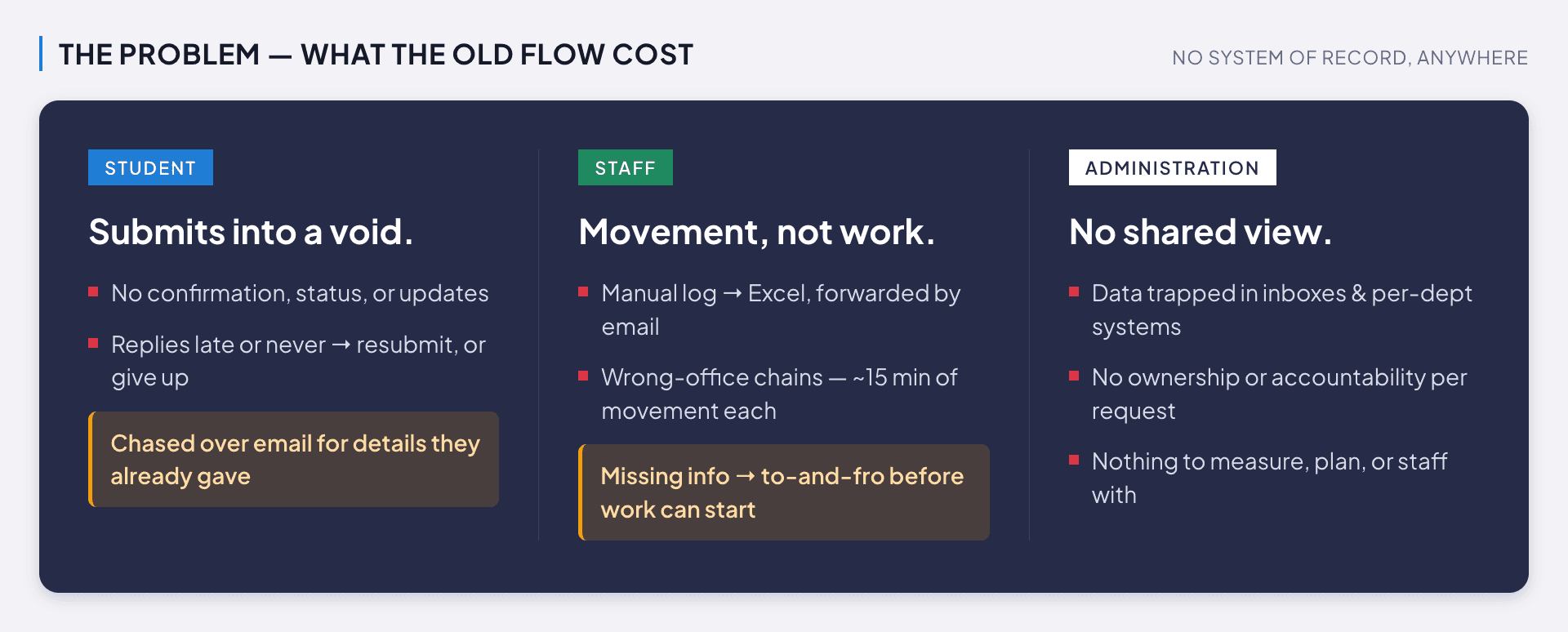
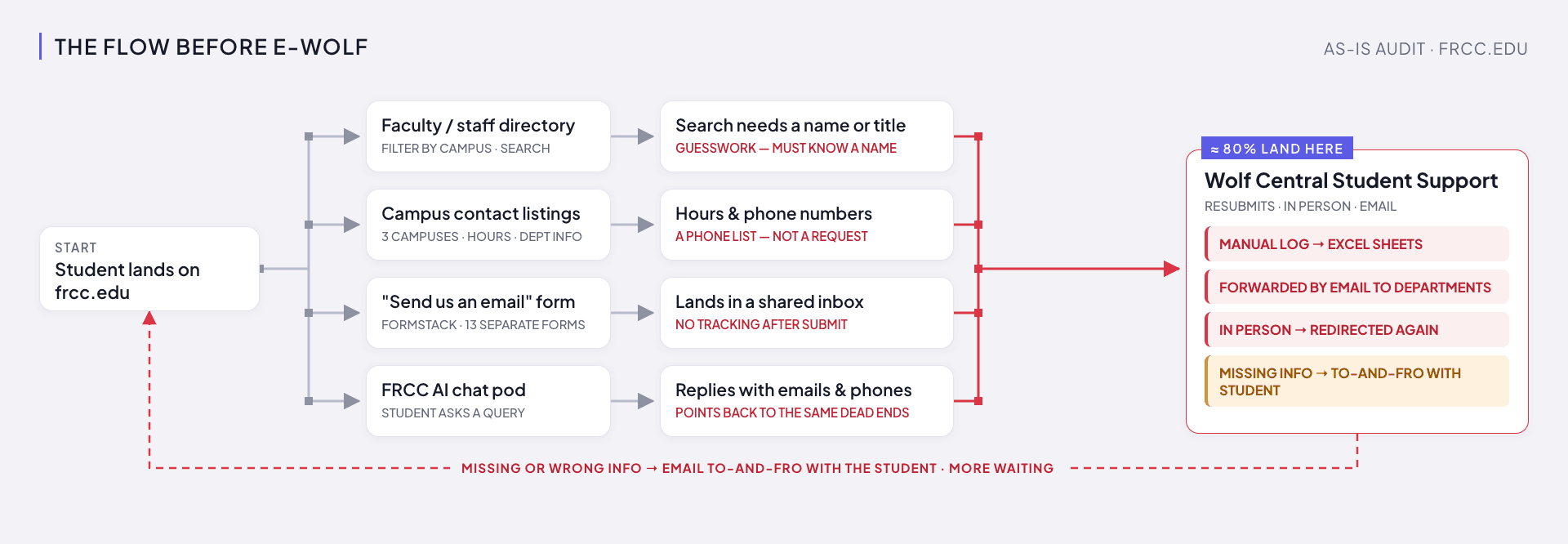
Before E-Wolf, support requests had no single path. Students guessed a department from a dropdown, resubmitted when nothing came back, or walked into Wolf Central, where roughly 80% of all requests eventually landed. Staff logged them by hand in Excel and forwarded them over email, leaving requests untracked, students without updates, and administration without a shared view.
E-Wolf replaces that maze with one front door: a single request form where AI reads the student's own words and scores confidence. Every request now moves through one tracked pipeline that students can follow, staff can act on, and administration can finally see.

User research process & plan
I used a mixed-method approach to understand FRCC's fragmented support ecosystem and identify where student requests, staff workflows, and AI chat interactions were breaking down.
9 semi-structured interviews and survey responses to understand how students found departments, accessed resources, and resolved issues.
5 staff interviews to understand intake workflows, misrouted requests, resolution time, and cross-department communication.
Executive member of FRCC's SEM Institutional Excellence Initiative, leading 4 months of institutional research across the college with 15 meetings and 10+ interviews.
3 discussion sessions focused on technology infrastructure needs and declining admissions from 2024 to 2026.
6 months of data analysis across 5,417 Chat Pod conversations, where 1,242 were issue-resolution requests requiring human support.
Evaluated a build partner for LLM training and routing infrastructure due to limited internal engineering capacity.


User research results & insights
I found that FRCC's support experience was fragmented across students, staff, leadership, and AI chat, creating friction in help discovery, request handling, and accountability.
8 out of 10 students struggled to find the right department or contact information. 7 out of 10 students preferred emailing or visiting Wolf Central in person. 9 out of 10 students did not trust Apollo to resolve their issue.
150+ requests per day were handled by Wolf Central, rising to 400+ during peak periods. Requests were logged in Excel, making tracking and ownership difficult.
16 out of 18 staff members asked for a centralized system to improve capacity and cross-divisional accountability.
Board discussions reinforced the need for intentional enrollment pipelines and centralized data collection.
789 of 1,242 support-seeking conversations (63%) ended in dead ends and required human intervention.
$300K secured by pitching Gecko as the build partner for phase 1 design and implementation.


Chat Pod: from answers to cases
Analysis of 5,417 Chat Pod conversations showed that 1,242 were issue-resolution requests requiring human support. Of those, 789 (63%) ended in dead ends, leaving students without a clear path to resolution.
Chat Pod handled the question layer, but it couldn't own the case layer. In FRCC's first two-month soft launch, the team saved approximately 106 hours; however, over six months, 789 of 1,242 support-seeking conversations still ended in dead ends and required human intervention.
To close that gap, I embedded the E-Wolf Support intake form directly into the chatbot experience, turning unresolved or cross-department requests into structured, trackable support cases without forcing students to restart elsewhere. The result was a more seamless handoff from self-service to support, with better ownership, preserved context, and fewer dead ends for complex student needs.

Routing logic
At submission, each request is scored by the model with a confidence value, classification label, and prospective-student tag. Requests scoring 90+ auto-route to the department queue, 70–89 are sent to the review gate for manager confirmation, and anything below 70 is held for human triage at Wolf Central Student Support.

How a request moves through E-Wolf
A single request defines the entire flow. A student writes their issue in their own words; the AI proposes a clearer version, declares the destination department, and keeps the original one click away. From there, the confidence score determines whether the request auto-routes, is suggested for review, or is held for human triage at Wolf Central.
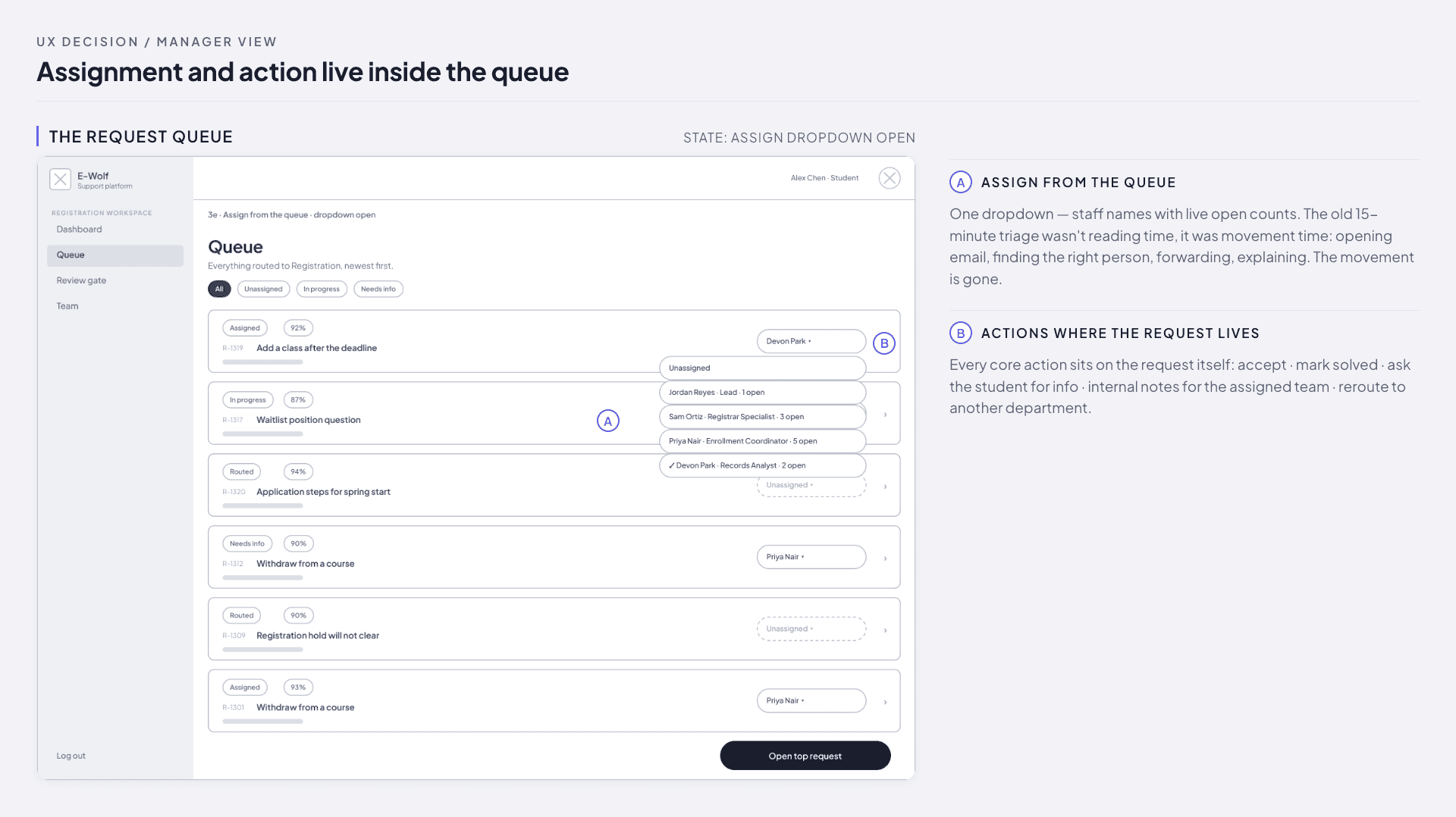
In the department view, the request lands in a live queue where managers assign, act, and move it through the workflow: accept, resolve, request more information, add internal notes, or reroute with a reason. Each reroute becomes labeled training data, turning everyday decisions into continuous model improvement. The student sees status at every stage; administration sees the full system on a live dashboard.

Design System
To make the student portal, department application, and administration dashboards feel like a single product, I designed a shared system that could flex across three distinct audiences and workflows. The same component library, status language, and interaction patterns created consistency across the experience, while role-based permissions and WCAG-first accessibility kept the system usable, scalable, and inclusive from the start.

Product description
E-Wolf is a centralized request intake and routing platform accessible through FRCC's student portal, Apollo AI chat, and the admissions portal. It gives students a single entry point for support, routes requests into department queues, and gives administrators live data visibility into request flow and performance.
Student experience
Students can submit any issue or question through one request form. The AI structures the request, suggests the right department, and lets students restore the original draft before sending. Students can also track request status live and receive email updates along the way.


Staff experience
Staff work from a unified departmental queue where routed requests arrive with confidence scores and classification context. Managers can review low-confidence requests, assign work, reroute items, and monitor team progress, while support staff handle day-to-day resolution, request more information, and add internal notes.
Department manager experience
Managers see incoming requests in one queue and can review, assign, or reroute them as needed. They also monitor request volume, resolution progress, and low-confidence cases in real time.
Support staff experience
Support staff can accept, resolve, request more information, add internal notes, or flag a request for rerouting. Each correction is captured as labeled training data to improve routing quality over time.




Administration/ Board Members experience
Administrators can view live request activity across all three campuses through shared dashboards. They can filter by location and monitor volume, routing accuracy, triage time, resolution trends, and intake source.


Human-in-the-loop AI
E-Wolf uses AI across five points in the request lifecycle to improve routing without removing human oversight. The model assists with request drafting, pre-declares the destination department, classifies each request against four taxonomies with a confidence score, auto-routes only above a defined threshold, and learns from manager corrections to continuously improve routing accuracy.
This approach made AI a product mechanism, not a standalone feature: it reduced manual triage, preserved control on ambiguous requests, and created a feedback loop that improved the system with every review. The result was a routing workflow that scaled operationally while staying safe, explainable, and responsive to real staff decisions.

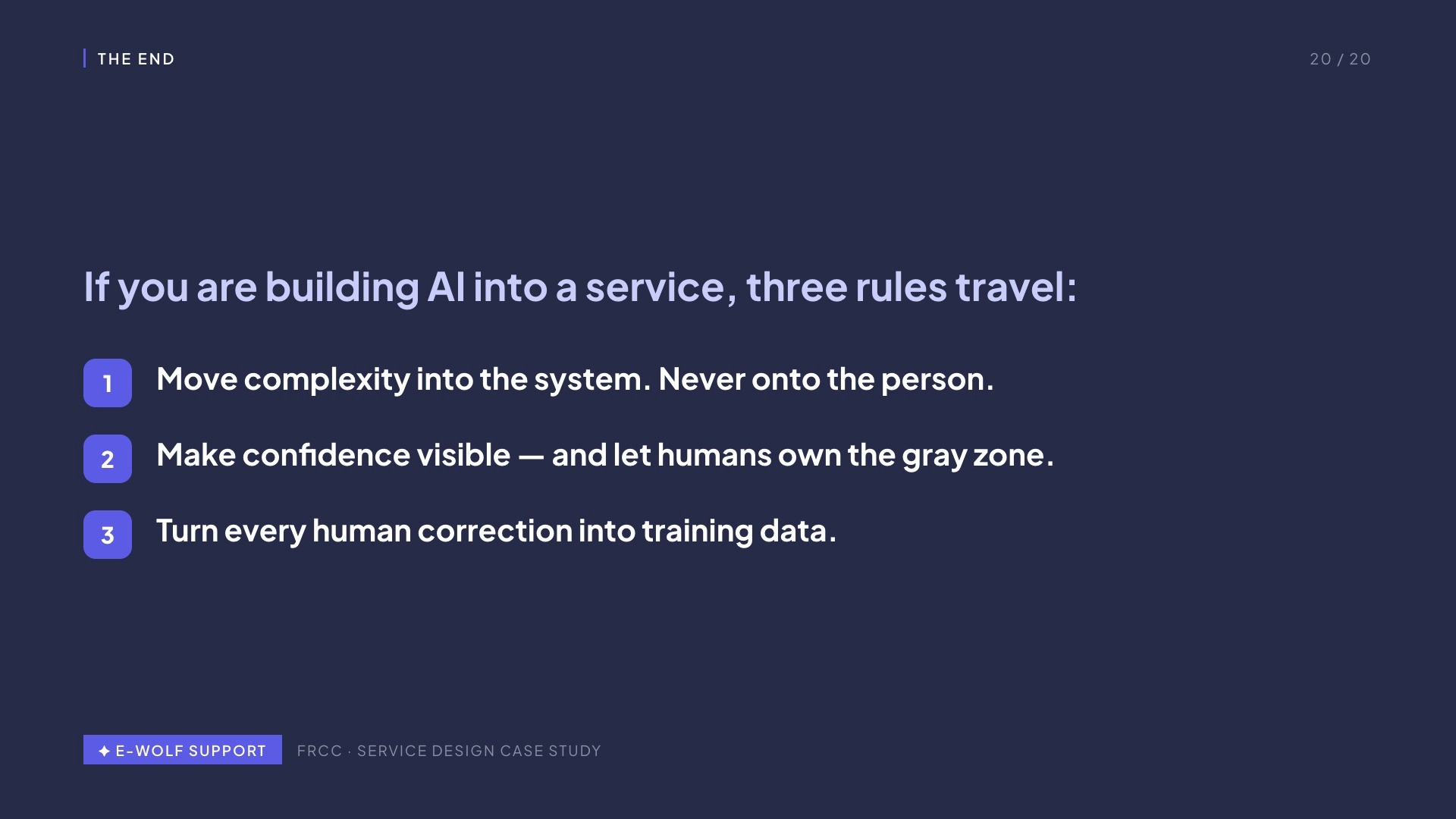
Takeaways
Evidence before design: 789 dead-end Apollo conversations gave me both the entry point and the proof that the existing experience was failing.
Trust is designed, not assumed: the confidence gate earned staff trust by allowing the system to admit uncertainty instead of guessing.
Corrections are a feature: each staff reroute became labeled training data, turning daily work into a feedback loop that improved routing over time.
Design for the organization, not just the user: I designed the routing logic to hold together student, staff, and administration experiences as one system.
Phase 2 was earned: proving value in student and staff services first opened the path to expand into marketing, sales, and operational services.